
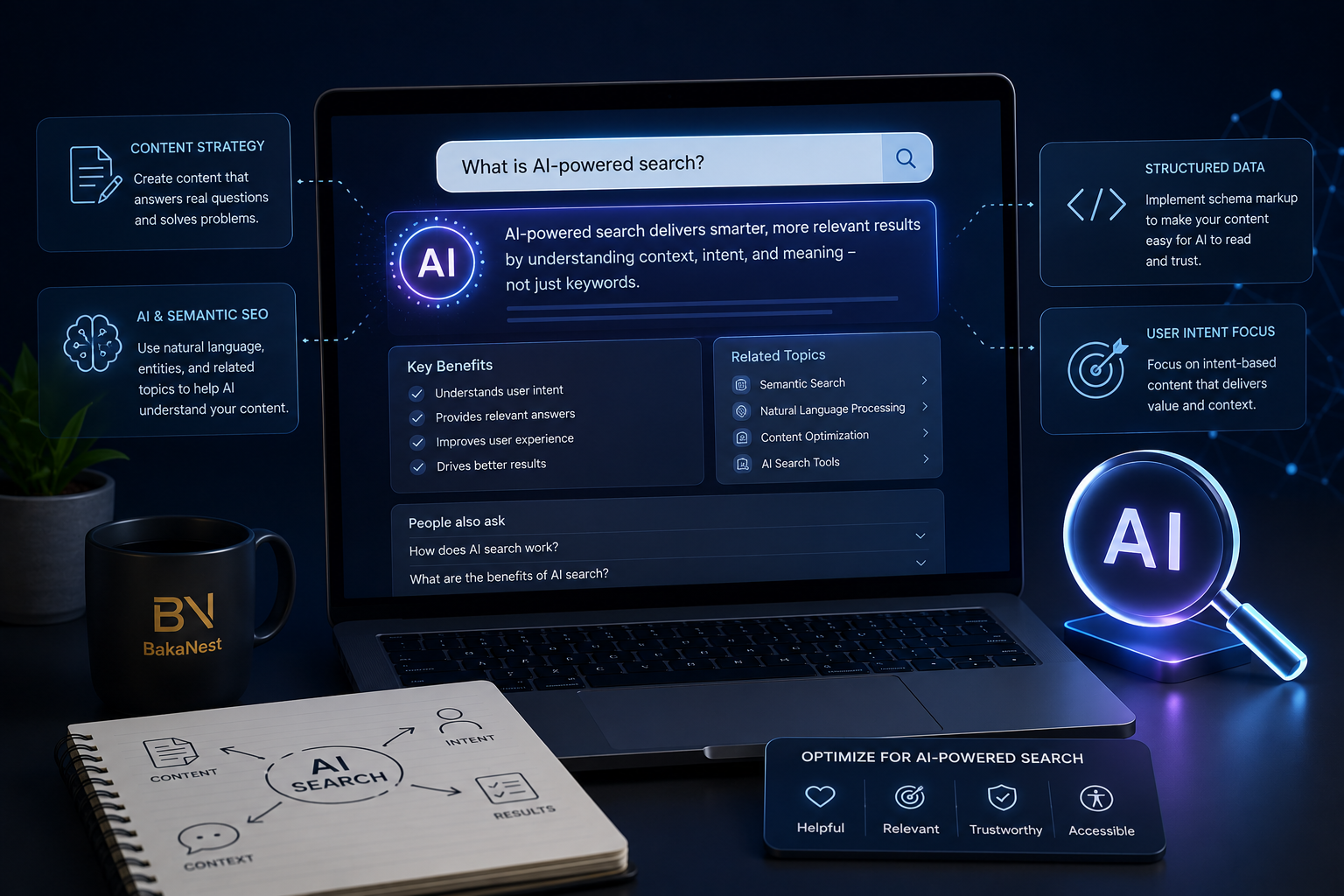
AI-powered discovery still depends on useful information, clear structure, and evidence that readers and search systems can understand.
Search experiences are changing from lists of links into combinations of summaries, direct answers, recommendations, conversations, and cited sources. People may discover a brand through a traditional result, an AI-generated overview, a chatbot response, or a follow-up question that narrows their original need.
The format is new, but the content requirement is familiar: publish information that is accurate, specific, well organized, and worth referencing. Content designed only to attract a click is less useful in an environment where systems attempt to answer the question before the user visits a page.
Understand how AI-powered discovery changes the journey
Traditional search often encourages a sequence: enter a query, review results, choose a page, and refine the search if necessary. AI interfaces can combine several parts of that sequence into one conversation.
A person might begin with a broad question, ask for a comparison, add a budget or technical constraint, and request a recommendation. The system may assemble information from several sources at each step.
This changes the role of content. A page can contribute to discovery even when it is not the final destination. It might provide a definition, a statistic, an example, a decision criterion, or evidence that supports a synthesized answer.
Businesses should therefore create content that works at multiple stages:
- Clear explanations for early research
- Specific comparisons for evaluation
- Detailed proof for validation
- Accurate product and service information for decisions
- Helpful next steps when a user is ready to act
Lead with a direct, useful answer
Readers should not need to cross a long introduction before learning whether a page addresses their question. State the central answer early, then add context, evidence, exceptions, and examples.
This does not mean every paragraph should be reduced to a short definition. It means the structure should respect the reader’s intent. A strong section often follows a simple pattern:
- Answer the question in plain language.
- Explain why the answer is true.
- Add a concrete example or supporting detail.
- Clarify where the answer changes or has limitations.
That pattern creates passages that are understandable on their own while remaining connected to a deeper article.
Content becomes easier to reference when the answer is clear, the context is nearby, and the evidence is visible.
Structure pages around meaningful questions
Descriptive headings help readers scan and give search systems a clearer map of the page. A heading such as “How long does implementation take?” communicates more than “Timeline.” A section called “When this approach is not suitable” adds valuable decision context that promotional pages often omit.
Organize the page around the natural sequence of a user’s questions:
- What is it?
- Who is it for?
- What problem does it solve?
- How does it work?
- What are the benefits and limitations?
- How does it compare with alternatives?
- What does it cost or require?
- What should someone do next?
Not every page needs all of these sections. Choose the questions that match the subject and stage of the journey.
Write self-contained passages without creating repetition
AI systems may extract or summarize a small portion of a page. Important passages should retain their meaning when viewed outside the full article. Use explicit nouns instead of relying constantly on words such as “it,” “this,” or “they” when the reference could become unclear.
For example, “Server-side rendering can improve initial content delivery for dynamic pages” is more portable than “It can improve delivery.”
Self-contained does not mean repeating the full topic in every sentence. It means each section introduces enough context for the reader to understand the claim, its subject, and its boundaries.
Add information that only experience can provide
Generic summaries are easy to reproduce. Original details make content useful and distinguishable. Businesses have valuable knowledge in project decisions, customer questions, implementation challenges, internal data, and lessons from real outcomes.
Strong supporting material can include:
- A step-by-step process used in real work
- An anonymized example with concrete constraints
- Original survey or product data
- A comparison based on defined evaluation criteria
- Screenshots, diagrams, or demonstrations
- Common failure modes and how to avoid them
- A clear explanation of trade-offs
The aim is not to reveal confidential information. It is to move beyond statements that could appear on any competitor’s website.
Make claims easy to verify
Credibility matters when a system chooses which information to reference and when a person decides whether to trust the answer. Factual claims should have visible support.
Link to primary sources where possible, name the methodology behind original data, and distinguish observation from opinion. Dates matter for information that changes over time. Authors and reviewers matter when expertise is relevant.
A credible page makes it easy to answer:
- Who created or reviewed this information?
- When was it published or updated?
- What evidence supports the main claims?
- Is the source speaking from direct experience?
- Are limitations and uncertainty acknowledged?
Avoid adding citations merely for appearance. The source should genuinely support the nearby claim.
Keep entities and terminology consistent
Search systems build understanding through relationships between people, organizations, products, places, and concepts. Inconsistent names create unnecessary ambiguity.
Use one primary name for the business and each product or service. Explain abbreviations when they first appear. Keep company details, descriptions, authorship, and product attributes consistent across the website and relevant external profiles.
When discussing a specialized concept, define it before using shorthand. Clear terminology helps both newcomers and systems interpret how the subject relates to adjacent ideas.
Build topic depth through connected pages
A single large article cannot answer every useful question well. A connected content system can combine a central overview with focused supporting pages.
For example, a product engineering topic might include:
- A cornerstone guide explaining the overall process
- A focused article about MVP scope
- A comparison of architecture options
- A case study showing a real delivery decision
- A checklist for preparing a product brief
Internal links should explain the relationship between these pages. The overview helps visitors understand the landscape, while supporting pieces provide depth for a particular need.
This approach is more helpful than publishing many disconnected articles around slight keyword variations.
Support machines with sound technical foundations
Well-written content still needs to be accessible. Important information should be available in rendered HTML, connected through crawlable links, and associated with clear metadata.
Technical foundations include:
- Descriptive page titles and main headings
- Canonical URLs and consistent index signals
- Fast, stable mobile rendering
- Semantic HTML for headings, lists, tables, and navigation
- Descriptive alternative text for meaningful images
- Structured data that accurately reflects visible content
- XML sitemaps and sensible internal linking
Structured data can clarify the type and properties of content, but it cannot compensate for thin or inaccurate copy. Use it to describe what genuinely exists on the page.
Create formats that match the information
Different questions benefit from different presentations. A short definition works in prose. A feature comparison may be clearer in a table. A process may need numbered steps. A relationship between systems may benefit from a diagram.
Choose the format that minimizes interpretation:
- Use lists for distinct items or requirements.
- Use tables for repeated, comparable attributes.
- Use steps for ordered actions.
- Use examples to turn abstract guidance into a concrete decision.
- Use concise summaries before detailed explanations.
Do not force every page into a rigid template. Consistent structure is valuable, but the format should serve the subject.
Answer comparison and decision questions honestly
AI-assisted search is well suited to questions such as “Which option is better for my situation?” Content that explains trade-offs can be more valuable than content that declares one universal winner.
A useful comparison defines its criteria first. Those might include cost, implementation speed, control, scalability, maintenance, integration needs, or team capability. Explain which option fits which circumstances and identify cases where the business’s own offer is not ideal.
Honest boundaries increase trust. They also make the page relevant to more specific, qualified questions instead of only broad promotional searches.
Keep commercial information precise
Product and service pages should contain the details people need to evaluate an offer. Vague claims such as “flexible solutions” or “industry-leading results” provide little material for comparison.
Where appropriate, explain:
- The intended customer or use case
- Included capabilities and deliverables
- Prerequisites and integrations
- Typical process or timeline
- Pricing model or factors affecting cost
- Support and maintenance arrangements
- Limitations or exclusions
Precise information helps AI systems represent the offer accurately and helps prospective customers decide whether to continue the conversation.
Maintain freshness with purpose
Some information is durable; other information changes frequently. Updating a date without reviewing the content does not make a page current.
Establish review intervals based on risk. Product features, prices, regulations, statistics, and tool instructions may require frequent checks. Principles, frameworks, and historical explanations may remain accurate longer.
During a review:
- Verify facts, examples, and external references.
- Check whether the search intent or audience has changed.
- Replace outdated screenshots or processes.
- Clarify sections that generate support questions.
- Add meaningful new evidence when available.
- Record the update transparently.
Removing or consolidating weak content can be as valuable as publishing something new.
Measure visibility beyond the traditional click
AI search can influence awareness without always producing a direct visit, which makes measurement more difficult. No single metric captures the whole effect.
Use a combination of signals:
- Search impressions and clicks for relevant topics
- Referral traffic from AI and search platforms when identifiable
- Growth in branded searches and direct visits
- Mentions and citations observed across important queries
- Engagement and conversion on pages that receive discovery traffic
- Customer conversations about how they found the business
Treat citation monitoring as directional rather than absolute. Responses vary by prompt, location, model, and time. The business outcome remains more important than appearing in one generated answer.
Avoid shortcuts designed only for AI systems
There is no durable substitute for useful information. Publishing large volumes of lightly differentiated pages, hiding blocks of machine-targeted text, or adding unsupported claims may create noise without building authority.
The same warning applies to AI-assisted content production. AI can help organize research, explore questions, and improve drafts, but final content needs human ownership. Someone must verify claims, add experience, protect confidential data, and ensure the page reflects the brand’s actual expertise.
Quality control should become stricter as production becomes faster.
An AI-search content checklist
Before publishing an important page, confirm that:
- The primary question and audience are clear
- The main answer appears early
- Headings describe meaningful questions or sections
- Important passages include enough local context
- Claims are supported and easy to verify
- The page adds original experience, evidence, or analysis
- Terms, names, and product details are consistent
- Related pages are connected with descriptive links
- The HTML, metadata, and index signals are sound
- The content has an owner and review date
- The next step for an interested reader is clear
Optimize for understanding
AI-powered search rewards many of the same qualities readers have always valued: direct answers, logical structure, credible evidence, practical depth, and honest limitations.
The opportunity is not to write for a mysterious machine. It is to make expertise easier to retrieve, interpret, and trust across more discovery experiences. Businesses that document what they know clearly and support it with real evidence create content that remains valuable whether the reader arrives through a blue link, a generated overview, or a conversational answer.