
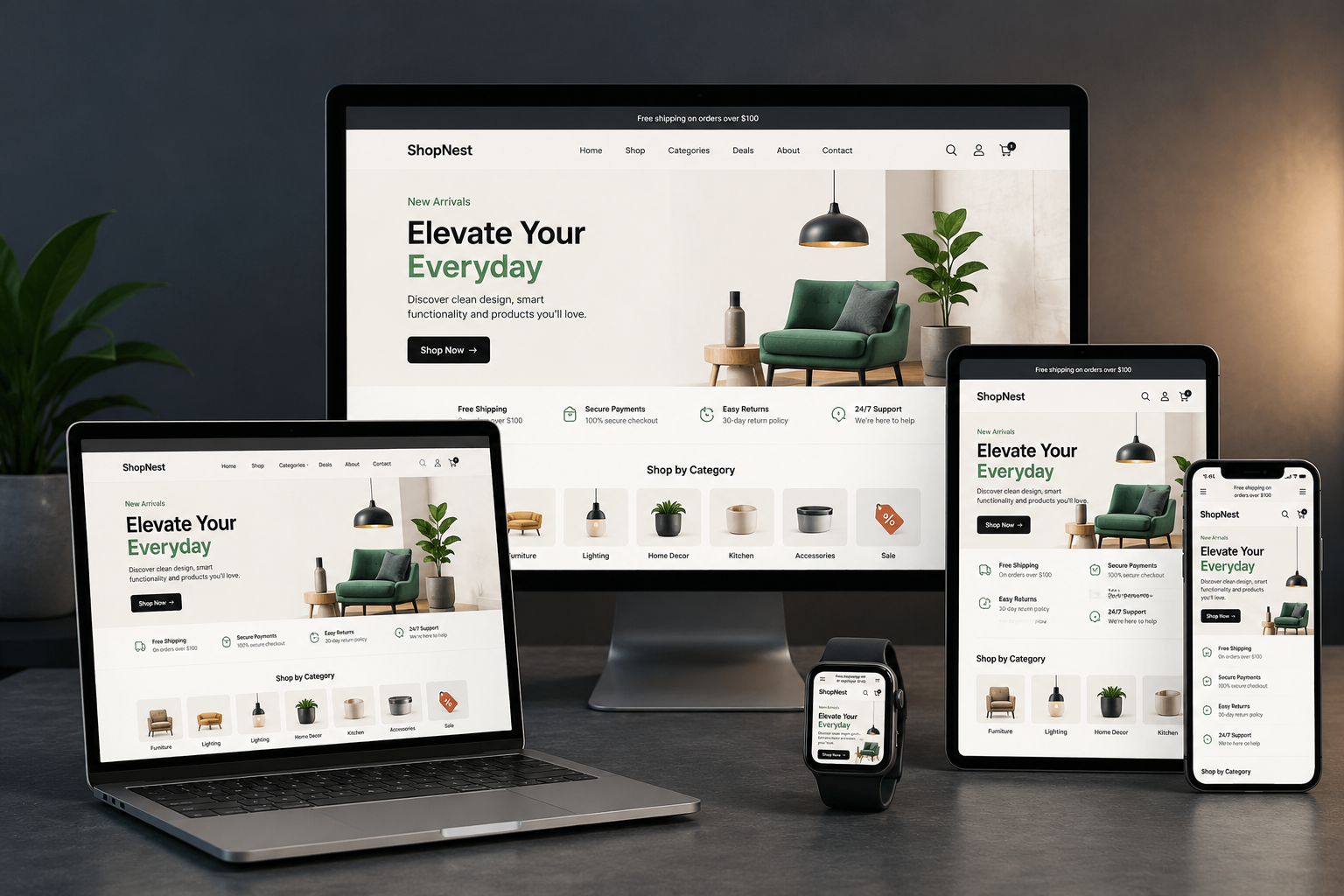
Platform choice should follow the business model, catalog needs, team capacity, and integration requirements.
The right e-commerce platform is not simply the one with the longest feature list. It is the one that supports how your business sells today while leaving enough room for the catalog, customers, channels, and operations you expect tomorrow.
A poor fit may look affordable at launch but become expensive through manual work, fragile integrations, limited checkout options, or constant development. A strong fit gives the team a dependable foundation without forcing the business to reorganize around the software.
Begin With the Business Model
Before comparing platforms, document how the business actually makes money. The requirements for a direct-to-consumer brand are different from those of a wholesaler, a marketplace, or a company selling subscriptions and services alongside physical products.
Clarify questions such as:
- Do you sell to consumers, businesses, or both?
- Are prices public, negotiated, tiered, or customer-specific?
- Do customers make one-time purchases or recurring payments?
- Will you sell in multiple countries, currencies, or languages?
- Do orders ship from one location, several warehouses, or external suppliers?
- Will the store support retail locations, marketplaces, or social-commerce channels?
- Does the buying journey require quotes, samples, approvals, or account managers?
These answers eliminate unsuitable options quickly. They also prevent teams from choosing a familiar platform and discovering later that a core business rule requires a workaround.
Understand Catalog Complexity
Catalog size alone does not determine complexity. A store with 100 highly configurable products may be harder to manage than one with 20,000 straightforward items.
Consider:
- The number of products, variants, and product attributes.
- Bundles, kits, subscriptions, and build-your-own configurations.
- Region-specific pricing or availability.
- Customer-specific catalogs and price lists.
- Digital goods, services, and physical inventory in the same order.
- Product relationships such as compatibility, replacements, and accessories.
- The source of truth for descriptions, media, specifications, and stock.
If product data already lives in an ERP or product information management system, the platform should consume that data reliably instead of becoming a second, conflicting source of truth.
Map the Full Commerce Operation
The storefront is only the visible part of an e-commerce system. Every order moves through payment, fraud checks, tax calculation, inventory allocation, fulfillment, communication, returns, and reporting.
Map the path from product discovery to post-purchase support. Identify every system and team involved. This exposes operational requirements that are easy to miss during a design-led platform comparison.
A fast, attractive storefront cannot compensate for an order process that creates hours of manual work behind the scenes.
Pay particular attention to exceptions. Split shipments, backorders, cancellations, partial refunds, exchanges, and failed payments often reveal more about platform suitability than the ideal purchase journey.
Evaluate Integration Requirements Early
Most growing commerce businesses depend on a connected ecosystem that may include:
- Enterprise resource planning and inventory systems.
- Customer relationship management software.
- Warehouse and shipping providers.
- Payment gateways and fraud-prevention services.
- Tax, accounting, and reconciliation tools.
- Product information and digital asset systems.
- Email, loyalty, reviews, and customer-support platforms.
- Analytics and business-intelligence tools.
Ask whether reliable, supported integrations already exist. If custom development is required, investigate the platform’s APIs, webhooks, rate limits, documentation, and extension model.
An integration is not complete when data moves once. It needs monitoring, retry behavior, error reporting, and a clear owner when systems disagree.
Hosted, Open Source, or Headless?
Architecture should match the team’s needs and ability to operate it.
Hosted platforms
Hosted software typically provides infrastructure, security updates, platform maintenance, and a managed checkout. It can shorten the path to launch and reduce operational responsibility.
The tradeoff is working within the platform’s extension boundaries. Complex business logic may require apps, premium plans, or compromises.
Open-source platforms
Open-source software offers deeper control over code, hosting, data, and customization. It can be a good fit for businesses with specialized processes and an experienced technical team.
That flexibility comes with responsibility for upgrades, performance, security, compatibility, and ongoing maintenance.
Headless commerce
Headless architecture separates the customer-facing experience from the commerce engine. It can support distinctive experiences, multiple front ends, and stronger control over performance and content.
It also introduces more components, integration work, testing, and deployment responsibility. Headless is valuable when those benefits solve a real requirement—not simply because it is a modern architecture.
Calculate Total Cost of Ownership
Subscription price is only one part of platform cost. Build a three-year estimate that includes:
- Platform and hosting fees.
- Transaction and payment-processing charges.
- Themes, applications, extensions, and third-party services.
- Initial design, development, migration, and integration work.
- Testing, security, monitoring, and performance optimization.
- Ongoing support, upgrades, and feature development.
- Internal time spent managing products, orders, and exceptions.
- Revenue risk from downtime or checkout limitations.
A less expensive license can produce a higher total cost if the team needs multiple paid extensions or repeated manual intervention. Conversely, an enterprise platform is not automatically safer if its complexity exceeds the organization’s needs.
Protect Performance and Conversion
Platform decisions affect the buying experience directly. Assess real storefronts built on each candidate, especially on mobile devices and slower connections.
Review:
- Product and category-page performance.
- Search and filtering responsiveness.
- Cart and checkout friction.
- Support for preferred payment methods.
- Accessibility and keyboard navigation.
- Image optimization and content delivery.
- The effect of third-party scripts and applications.
Performance should be treated as an operational metric. A store may start quickly and become slower as marketing tools, tracking scripts, and apps accumulate.
Plan for Search and Content
Commerce growth often depends on more than product pages. Buying guides, comparison pages, collections, editorial content, and landing pages help customers discover and evaluate products.
Confirm that the platform provides control over URLs, metadata, redirects, structured data, canonical tags, navigation, and internal linking. The content workflow should let marketing teams publish safely without depending on a developer for routine changes.
For a migration, preserve valuable URLs and plan redirects before launch. Search visibility can be damaged when platform implementation treats content history as an afterthought.
Make Security and Compliance Explicit
Security responsibilities vary by platform and architecture. Define who manages software updates, access controls, backups, vulnerability monitoring, payment compliance, privacy requirements, and incident response.
Also examine administrative permissions. Teams should be able to give staff and partners only the access they need, protect sensitive actions with strong authentication, and review important account activity.
Test With Real Scenarios
Feature comparison tables rarely show how a platform behaves in daily work. Create a short list of realistic scenarios and test them through demonstrations or a proof of concept.
For example:
- Add a product with variants, media, and regional pricing.
- Apply a promotion with exclusions and a minimum order value.
- Complete a mobile purchase with the preferred payment method.
- Split an order across two fulfillment locations.
- Process a partial refund and inventory adjustment.
- Update customer details across connected systems.
- Publish a campaign landing page without developer support.
- Investigate a failed integration event.
Include the people who will operate the store. Their experience exposes friction that a technical or executive evaluation may overlook.
Use a Weighted Decision Framework
Separate essential requirements from preferences and assign a weight to each area. A practical scorecard might cover:
- Business-model fit.
- Catalog and pricing flexibility.
- Checkout and customer experience.
- Operations and order management.
- Integration capability.
- Content, SEO, and marketing control.
- Security and compliance.
- Team usability.
- Scalability and performance.
- Three-year total cost.
Score evidence, not promises. Note whether each capability works natively, needs a supported extension, requires custom development, or is unavailable. This makes tradeoffs visible and prevents one impressive demonstration from dominating the decision.
Prepare for Migration Before Committing
A platform choice is only as successful as its implementation. Audit product, customer, order, and content data before migration. Decide what should be cleaned, archived, transformed, or left behind.
Plan integrations, redirects, analytics, training, testing, and rollback procedures early. Run a controlled launch checklist that covers storefront behavior and back-office operations, including the exceptions that occur on a normal trading day.
Choose for the Next Stage of Growth
Avoid selecting for an imagined future that may never arrive, but do not optimize only for launch day. The best choice usually supports the next meaningful stage of growth without requiring unnecessary infrastructure now.
Start with the business model, examine the entire operation, and test each platform against real scenarios. When architecture, cost, integrations, and team capacity are evaluated together, the decision becomes clearer—and the resulting commerce system is far more likely to keep supporting the business as it grows.