
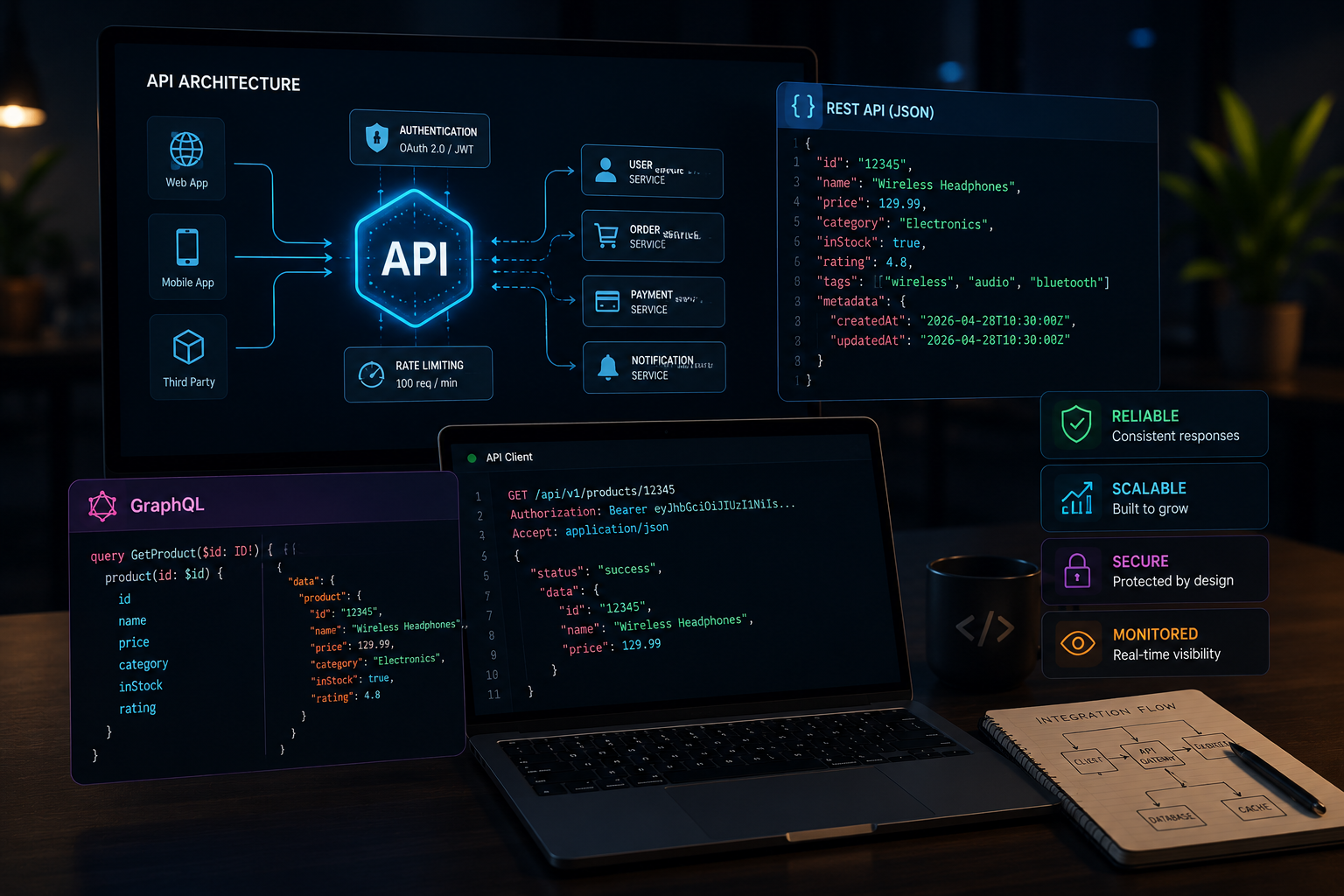
Reliable integrations make failure visible, retries safe, and responsibilities between systems explicit.
Connecting two systems is often easy in a prototype. An application sends a request, receives a response, and moves on. The real challenge begins after launch, when traffic grows, data changes, credentials expire, providers have outages, and the same event arrives more than once.
A dependable integration assumes these conditions will happen. It treats failure as part of normal operation and gives teams the information and controls they need to recover safely.
Define Ownership Before Writing Code
Every integration needs clear boundaries. Decide which system owns each piece of data, which system may update it, and what should happen when two sources disagree.
For example, a CRM might own customer contact details while an ERP owns invoices and account status. Copying those fields between systems does not make both systems authoritative. Without an explicit source of truth, updates can circulate, overwrite newer information, or create records that nobody trusts.
Document:
- The source of truth for every important entity and field.
- Which events trigger data movement.
- Whether updates travel in one direction or both.
- The identifiers used to match records between systems.
- Which team owns the integration and handles failures.
- The acceptable delay between a change and its destination.
This agreement is part of the architecture. It prevents technical decisions from silently becoming business rules.
Design an Explicit Integration Contract
An integration contract describes more than an endpoint. It defines the request and response formats, required fields, validation rules, authentication, error behavior, versioning, and performance expectations.
Keep the contract narrow and intentional. Avoid exposing an internal database model directly, because internal fields and relationships will change. A stable API should represent the capability another system needs rather than the storage structure behind it.
Useful contracts also distinguish between:
- A request that was accepted.
- A request that completed successfully.
- A temporary failure that may be retried.
- A permanent validation or permission failure.
- A duplicate request that was already processed.
Clear semantics allow consumers to respond correctly instead of guessing from a generic error message.
Expect Networks to Fail
Timeouts, dropped connections, rate limits, and short provider outages are ordinary conditions in distributed systems. A request may even succeed remotely while the response is lost, leaving the caller unsure whether it should try again.
Set explicit connection and request timeouts. Avoid waiting indefinitely, and do not use the same timeout for every dependency. A user-facing request may need a fast fallback, while a background synchronization job can wait longer.
When a dependency is unavailable, preserve the work where appropriate and process it asynchronously. Queues can absorb short disruptions and prevent one slow provider from exhausting the resources of the entire application.
Reliable integrations are not those that never fail. They are those that fail predictably and recover without corrupting data.
Make Retries Safe With Idempotency
A retry should not create a second customer, charge a card twice, or submit a duplicate order. Operations that may be repeated need idempotent behavior: processing the same request again produces the same intended result.
Common techniques include:
- Accepting an idempotency key with create or payment requests.
- Storing the key with the original result for a defined period.
- Using a stable external identifier when creating synchronized records.
- Enforcing unique constraints at the database level.
- Recording processed webhook event identifiers.
Retries should use exponential backoff with random jitter so multiple workers do not repeatedly hit a recovering service at the same moment. Set a maximum attempt count and move exhausted work to a review queue instead of retrying forever.
Treat Webhooks as Untrusted, Repeatable Events
Webhooks are useful because they reduce polling and shorten synchronization delays, but delivery is rarely exactly once. Events may arrive late, out of order, more than once, or not at all.
A robust webhook receiver should:
- Verify the signature using the raw request body.
- Validate the event type and essential fields.
- Store the event or enqueue it durably.
- Return a successful acknowledgement quickly.
- Process the business logic outside the request where possible.
- Record the provider’s event identifier to prevent duplicate effects.
Do not assume event order represents current state. For important updates, fetch the latest resource from the provider or compare versions and timestamps before applying a change.
Separate Transport From Business Logic
API-specific code should not be scattered through the application. Place authentication, request construction, response parsing, retry rules, and provider error translation behind a focused client or adapter.
The rest of the product can then work with business concepts such as createShipment, syncCustomer, or issueRefund instead of provider-specific endpoints and payloads.
This separation makes integrations easier to test and change. If the provider introduces a new API version—or the business moves to a different service—the impact remains concentrated at the boundary.
Validate Data at Every Boundary
External data should never be assumed to match your expectations. Validate types, formats, allowed values, ranges, and required relationships before using or storing it.
Validation also protects against quieter failures. A field that was once always present may become optional, a decimal may arrive as a string, or a new enum value may appear. Silently accepting malformed data can cause problems far from the original request and make diagnosis difficult.
Preserve enough context to investigate rejected records, but avoid logging sensitive payloads indiscriminately.
Secure the Whole Lifecycle
Security includes more than adding an API key to a request.
- Use short-lived credentials or scoped tokens when available.
- Grant only the permissions the integration needs.
- Store secrets outside source code and rotate them safely.
- Encrypt sensitive data in transit and at rest.
- Verify webhook signatures and protect against replay attacks.
- Restrict administrative and retry tools to authorized users.
- Remove credentials and personal information from logs.
- Maintain an audit trail for sensitive operations.
Plan credential rotation before it becomes urgent. The application should be able to accept a new secret without a risky deployment window or extended downtime.
Build Observability Into the Workflow
A server returning HTTP 200 does not prove an integration is healthy. A job may succeed technically while transferring incomplete data or updating the wrong record.
Track both technical and business signals:
- Request rate, latency, timeout rate, and error rate.
- Queue depth, retry count, and oldest pending job.
- Authentication and rate-limit failures.
- Records rejected by validation.
- Time since the last successful synchronization.
- Orders, payments, or customers processed per interval.
- Differences between source and destination totals.
Use structured logs with a correlation identifier that follows an operation across requests, jobs, and services. Alerts should describe the user or business impact and link to the information needed for investigation.
Handle Rate Limits Deliberately
Rate limits are not exceptional; they are part of the provider contract. Read the limit headers, pace requests, and coordinate usage across workers.
Batch operations when the provider supports them. Cache data that does not need to be fetched repeatedly, and use incremental synchronization rather than downloading every record on every run.
Prioritize work when capacity is constrained. A customer waiting for payment confirmation may be more urgent than a nightly analytics export.
Choose a Synchronization Strategy
Different data requires different consistency guarantees.
Synchronous requests work when the caller needs an immediate result and the dependency is fast and dependable. They also couple the user’s experience directly to the remote service.
Asynchronous events and jobs are better when work can complete later, needs retries, or may take significant time. They add operational components but isolate temporary failures.
Scheduled reconciliation provides a safety net. Even when webhooks handle real-time changes, a periodic job can find missed events, compare important records, and repair drift.
Many reliable systems use all three approaches for different parts of the workflow.
Plan for API Change
Providers change schemas, authentication methods, rate limits, and supported versions. Track deprecation notices and assign ownership for upgrades.
Use contract tests against realistic provider responses. Keep sample payloads for important cases, including errors and incomplete records. When adopting a new API version, run old and new behavior in parallel where risk justifies it and compare the results before switching fully.
Your own APIs need the same discipline. Prefer backward-compatible additions, publish migration guidance, and measure whether consumers still use a version before removing it.
Test Beyond the Happy Path
Integration tests should exercise the uncomfortable conditions that production will eventually produce:
- Slow responses and timeouts.
- Rate-limit responses.
- Expired or revoked credentials.
- Duplicate and out-of-order webhooks.
- Invalid and partially missing fields.
- Provider errors after partial completion.
- Queue retries and exhausted jobs.
- Large payloads and sudden traffic spikes.
- Recovery after an extended outage.
Use provider sandboxes where they are representative, but do not depend on them alone. Local fakes and recorded contract fixtures make failure behavior repeatable in automated tests.
Prepare an Operational Runbook
Someone will eventually need to answer: What failed? Which records were affected? Is it safe to retry? How do we confirm recovery?
A useful runbook explains how to inspect synchronization health, locate an operation by correlation ID, replay a failed event, reconcile missing data, rotate credentials, pause processing, and contact the provider. It should also identify actions that can cause duplicate or irreversible effects.
Build safe administrative tools for common recovery tasks. Directly editing production data should not be the normal way to repair an integration.
Reliability Is a Product Feature
Customers may never see an API integration, but they notice when stock is wrong, an order disappears, a refund is delayed, or support cannot find consistent information.
Reliable integrations come from explicit ownership, stable contracts, idempotent operations, controlled retries, strong security, and visibility across the full business workflow. Designing these qualities from the beginning costs less than repairing inconsistent data after the system has grown.
Start by defining what must remain true when a dependency is slow, unavailable, or sends the same event twice. That question turns a fragile connection into an integration the business can depend on.