
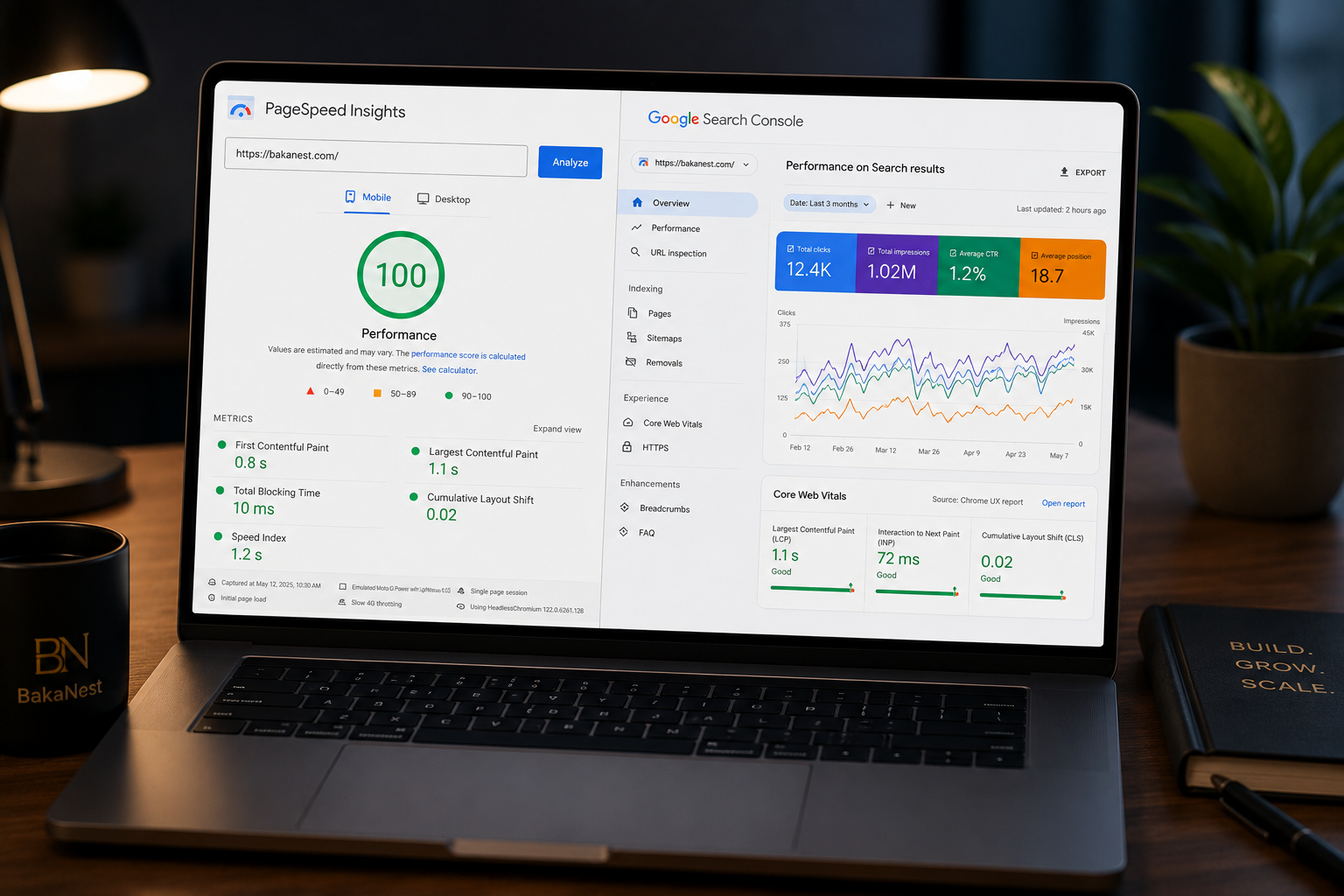
Website speed is not just a technical score. It shapes how quickly people understand an offer, how confidently they move through a page, and whether they stay long enough to take action. A fast website removes friction before visitors have time to notice it.
That makes performance a business advantage. It supports stronger conversion, better search visibility, a more inclusive experience, and a platform that is easier to grow without constantly fighting accumulated weight.
Speed shapes the first impression
Visitors begin judging a website before they read the first headline. A page that appears quickly feels responsive and dependable. A page that hesitates can make even a strong brand feel less polished.
The effect is especially important on mobile devices, where network conditions, processing power, and data limits vary widely. Every unnecessary script, oversized image, and blocking request asks the visitor to wait before receiving value.
A fast first experience helps people:
- See the primary message without delay
- Navigate without losing context
- Interact with buttons and forms confidently
- Browse more pages in a single session
- Complete important actions with less frustration
Performance is part of the experience. Visitors may never praise a fast page, but they immediately feel the friction of a slow one.
Faster journeys create better conditions for conversion
Conversion depends on momentum. Whether the goal is an enquiry, a purchase, a booking, or a sign-up, every pause creates another opportunity for someone to leave.
Speed does not fix an unclear offer or a confusing checkout, but it gives good content and design the best chance to work. Landing pages can reveal their value proposition sooner. Product pages can move smoothly into checkout. Forms can respond immediately instead of leaving users unsure whether an action succeeded.
The most useful way to connect performance with conversion is to look at complete journeys rather than a single homepage score. Test the pages that carry commercial intent:
- Campaign and organic landing pages
- Product or service detail pages
- Pricing and comparison pages
- Forms, carts, and checkout steps
- Confirmation and success states
A delay at any point can weaken the whole path.
Search visibility benefits from a better page experience
Search engines want to send people to pages that are useful and accessible. Performance supports that goal by making content available quickly and keeping the interface stable while it loads.
Core Web Vitals provide a helpful framework for measuring important parts of the experience:
- Largest Contentful Paint (LCP) looks at how quickly the main visible content appears.
- Interaction to Next Paint (INP) reflects how responsive the page feels when someone interacts with it.
- Cumulative Layout Shift (CLS) measures unexpected movement while content is loading.
These metrics should not become the entire SEO strategy. Relevant content, clear site structure, strong internal links, and trustworthy information remain essential. Performance strengthens those foundations by making pages easier for people and crawlers to access.
Mobile performance deserves priority
A page can feel fast on a developer’s laptop and still struggle on a mid-range phone over a busy mobile connection. Designing only for ideal conditions hides the experience many real visitors receive.
Mobile-first performance work means testing realistic devices and networks, keeping initial downloads small, and ensuring the most important content does not depend on a large bundle of JavaScript. It also means treating responsive images, readable typography, stable layouts, and touch-friendly controls as part of performance rather than separate concerns.
The goal is not to make the mobile version feel reduced. It is to deliver the essential experience with less waste.
Images are often the biggest opportunity
Images communicate quickly, but they are also among the most common causes of slow pages. A single unoptimized hero image can outweigh the rest of the page.
A disciplined image pipeline should:
- Resize assets to the dimensions in which they are displayed
- Generate modern formats such as WebP or AVIF where appropriate
- Provide multiple sizes for different screens
- Lazy-load images below the fold
- Reserve image dimensions to prevent layout movement
- Keep the main above-the-fold image discoverable and prioritized
Good optimization should preserve the creative intent. The aim is not visibly poor compression; it is delivering the right visual at the right size and quality for the visitor’s device.
JavaScript should earn its place
Modern websites can accumulate JavaScript through frameworks, analytics, chat tools, personalization, form providers, advertising, and embedded media. Each addition may appear small in isolation, but together they increase download, parsing, and execution time.
Content-focused pages often need far less client-side code than teams assume. Navigation, readable content, responsive layout, and many visual effects can work without shipping a large application to the browser.
For every script, ask:
- Does it support an important visitor or business outcome?
- Must it load on every page?
- Can it wait until after the main content is usable?
- Is a lighter implementation available?
- Is anyone reviewing whether it still provides value?
Third-party tools need particular attention because their behavior and weight can change outside the website team’s release cycle.
A strong technical foundation makes speed easier to protect
Performance improves when the delivery architecture matches the website. Marketing pages and editorial content are often well suited to pre-rendering, caching, and global content delivery networks. These approaches reduce the amount of work required for every request and create a fast, predictable baseline.
Useful foundations include:
- Prebuilt or server-rendered HTML for important content
- CDN caching close to visitors
- Compressed text assets and efficient protocols
- Sensible font loading with a limited number of variants
- Small, page-specific JavaScript bundles
- Stable component patterns with performance constraints
Architecture alone cannot guarantee speed, but it can make the fast path the default instead of requiring repeated rescue work.
Performance must be monitored over time
A website rarely becomes slow because of one dramatic decision. More often, weight arrives gradually: a new tracking tag, a larger campaign image, another font, a video embed, or a component that loads code everywhere.
Performance budgets turn expectations into practical limits. Teams can define thresholds for page weight, JavaScript, image size, or key experience metrics and check them during development and deployment.
Monitoring should combine two perspectives:
- Lab testing offers repeatable diagnostics in controlled conditions and helps identify the cause of a regression.
- Real-user monitoring shows what visitors actually experience across devices, locations, and network conditions.
Both are necessary. A lab score is useful for debugging, while field data reveals whether the product is genuinely fast for its audience.
Start with the pages that matter most
Performance programs can feel overwhelming when a large website has years of accumulated complexity. The fastest route to meaningful progress is to prioritize by user and business impact.
Begin with high-traffic landing pages and important conversion flows. Measure their current state, identify the largest bottlenecks, and fix issues that can be repeated across templates or components. An improvement to a shared header, image component, or font strategy may benefit hundreds of pages at once.
A practical order of work is:
- Measure key journeys on realistic mobile conditions.
- Fix oversized media and unstable layout elements.
- Reduce blocking resources and unnecessary JavaScript.
- Improve caching, delivery, and rendering strategy.
- Add budgets and monitoring to prevent regressions.
This turns performance from a one-time optimization sprint into a normal quality practice.
Fast websites create compounding value
A fast website gives every other investment more room to succeed. Campaign traffic reaches the message sooner. Search content is easier to access. Product journeys feel smoother. Accessibility improves for visitors using constrained devices or connections. Engineering teams spend less time responding to performance emergencies.
The winning approach is not to chase a perfect score at the expense of the product. It is to make deliberate choices, measure the experience that real visitors receive, and protect speed as the website evolves.
When performance is treated as part of design, content, engineering, and growth, a fast website becomes more than a technical achievement. It becomes a durable advantage.