
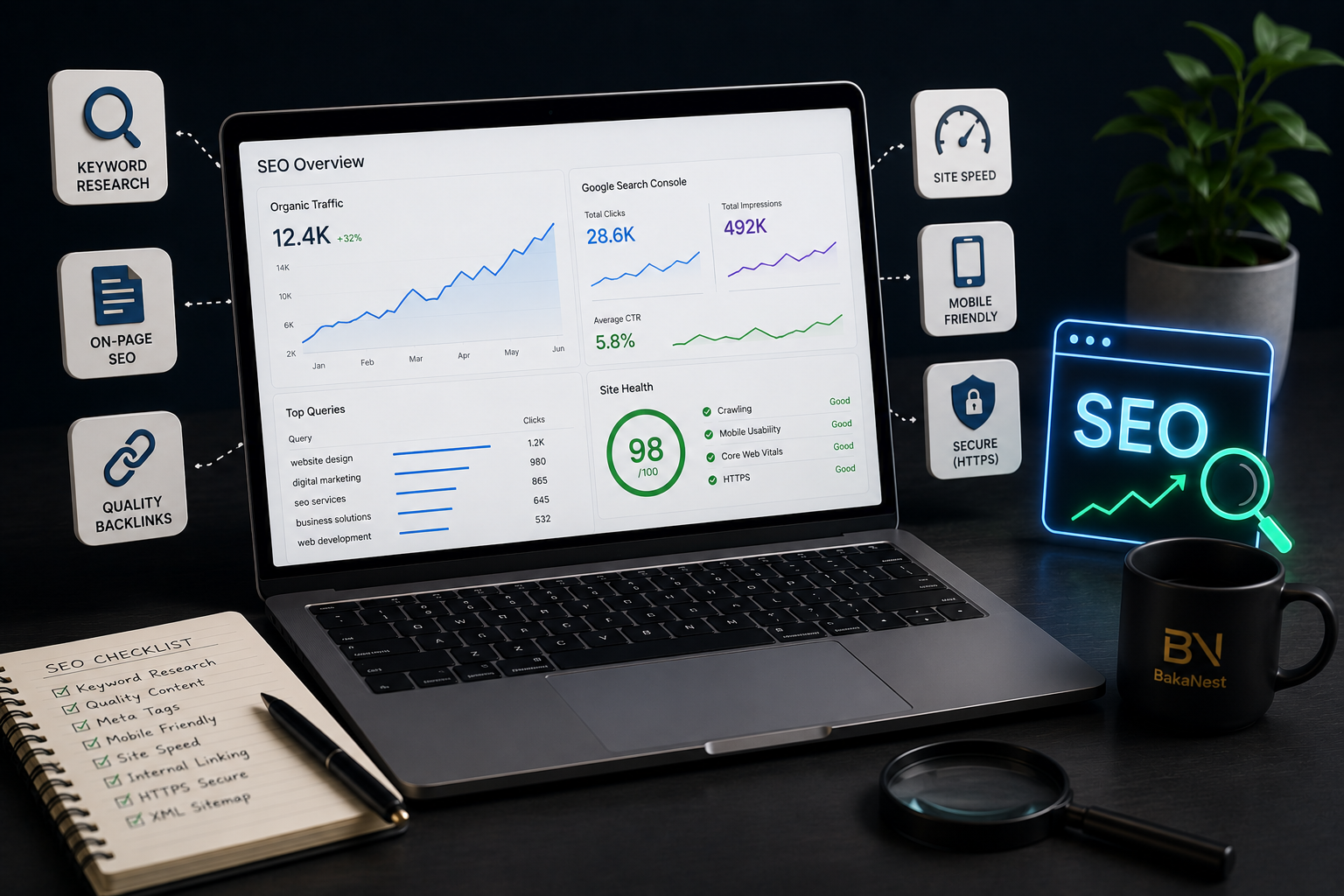
Strong organic visibility begins with accessible structure, useful content, clean metadata, and dependable performance.
SEO is most durable when it is treated as part of the website’s foundation rather than a set of adjustments made after launch. Search engines need to discover pages, understand what they offer, and see enough quality and context to consider them useful. Visitors need those same pages to be clear, trustworthy, and easy to navigate.
The strongest foundations align both needs. They make good content easier to find and make the website better for the people it is intended to serve.
Make every important page discoverable
A search engine can only evaluate pages it can reach. Important content should be connected through ordinary links in the site’s navigation, category pages, contextual copy, or related resources. Pages that exist only after a site search, form submission, or client-side interaction may be harder to discover consistently.
A clear site structure usually moves from broad to specific:
- The homepage introduces the business and its main areas.
- Section pages organize related services, products, or topics.
- Detail pages answer a focused need or query.
- Supporting resources provide depth and connect related ideas.
Keep the hierarchy understandable. A visitor should know where they are, how the page relates to the wider business, and where to go next. Search crawlers benefit from the same predictable paths.
An XML sitemap provides an additional discovery signal, especially for larger or frequently updated sites, but it does not replace good internal linking.
Give each page a clear purpose
Websites often create several pages that target nearly the same topic. This divides useful information across weak pages and makes it unclear which URL should represent the subject.
Each indexable page should have a distinct purpose, audience, and primary intent. A service overview can explain the broader offer, while a detailed service page addresses a specific need. A guide can educate, while a case study demonstrates an outcome. These pages can support one another without repeating the same message.
Before creating a page, define:
- The question or need it addresses
- The person most likely to need it
- The unique value it adds to the site
- The action a visitor should take next
- The existing pages it should link to and receive links from
If two planned pages cannot be distinguished clearly, one stronger page may be more useful than two competing ones.
Build content around real questions
Keywords are useful because they reveal how people describe problems, but a page should not be a container for repeated phrases. It should satisfy the intent behind the search.
A strong page anticipates the information someone needs to make progress. For a service page, that might include the problem being solved, the process, expected outcomes, suitable use cases, constraints, proof, and a clear next step. For an educational article, it may include a direct explanation, examples, trade-offs, and practical guidance.
Useful content tends to be:
- Specific enough to resolve the visitor’s question
- Structured so the main answer is easy to find
- Written from genuine experience or expertise
- Supported by examples, evidence, or transparent reasoning
- Updated when the underlying information changes
Search-focused content works best when optimization improves clarity instead of interrupting it.
Use titles and descriptions deliberately
The page title is one of the clearest signals of a page’s subject. It should describe the content accurately and distinguish the page from every other URL on the site. Put the meaningful topic early, keep branding consistent, and avoid vague labels such as “Solutions” without context.
Meta descriptions do not need to repeat the title. They can explain the benefit of the page and give searchers a reason to choose it. While search engines may generate a different snippet, a useful description still provides control when it is used.
Every important page should have:
- A unique, descriptive title
- A concise meta description
- One clear main heading
- Logical subheadings that reflect the content
- A readable, stable URL
- An intentional canonical URL
Metadata should be generated through reliable templates while still allowing page-specific editing. Templates prevent omissions; thoughtful exceptions keep important pages compelling.
Keep heading structure meaningful
Headings help visitors scan and help assistive technologies and search systems understand how ideas relate. Use a single main heading that states the page’s purpose, followed by second- and third-level headings that create a logical outline.
Do not choose heading levels for appearance. Styling can make any heading look larger or smaller. The markup should describe the information hierarchy.
Clear sections also improve content reuse in modern search experiences. A direct heading followed by a self-contained explanation makes it easier for readers and systems to identify the relevant answer without losing context.
Strengthen internal linking
Internal links connect related information, guide visitors toward useful next steps, and help search engines understand which pages are important.
Links are most valuable when they appear naturally in relevant context. Descriptive anchor text such as “technical SEO audit process” gives more information than “click here.” Supporting articles can link to a core service page, and the service page can link back to useful guides, examples, and case studies.
Review internal links when pages are added, merged, or removed. Orphaned pages receive no contextual links, while broken links waste visitor attention and crawler activity.
A simple internal-linking review asks:
- Which page is the primary resource for this subject?
- Which existing pages mention the topic and should link to it?
- What related question should the visitor explore next?
- Are the anchor words specific and natural?
Protect crawl and index signals
Technical directives tell search engines which pages may be crawled and indexed. Small mistakes can hide important content or expose low-value pages.
Core controls include:
- Robots.txt, which guides crawler access to areas of the site
- Meta robots directives, which control indexing at the page level
- Canonical tags, which identify the preferred URL for similar content
- Redirects, which preserve navigation and signals when URLs change
- Status codes, which communicate whether a page exists, moved, or failed
Use these controls for their intended purpose. Blocking a URL in robots.txt does not reliably remove it from an index, and a canonical tag is not a substitute for a redirect when a page has permanently moved.
Test production behavior after launches and migrations. A correct configuration in source code provides little value if a deployment rule, proxy, or CMS setting changes the final response.
Handle duplicate URLs consistently
The same content can become available through multiple URL variants because of tracking parameters, filters, trailing slashes, protocol differences, or duplicated CMS routes. A consistent URL policy prevents these variants from competing with one another.
Choose one format and enforce it through internal links, canonical tags, sitemap entries, and redirects where appropriate. Do not rely on search engines to guess which version the business prefers.
For filtered and faceted pages, decide which combinations provide meaningful standalone value. Useful category pages may deserve unique content and indexing. Near-infinite parameter combinations usually do not.
Make performance part of SEO quality
A technically indexable page can still provide a poor experience if it loads slowly, shifts while rendering, or responds late to interaction. Performance influences whether visitors remain engaged and whether content works well across devices and network conditions.
Focus on the pages that receive organic traffic and support important journeys. Common improvements include:
- Serving properly sized modern images
- Reducing unnecessary client-side JavaScript
- Loading fonts efficiently
- Reserving space for media and embeds
- Caching static assets through a CDN
- Rendering important content in the initial HTML
Measure both controlled tests and real-user performance. Lab tools explain potential problems; field data shows the experience visitors actually receive.
Design for mobile and accessibility
Search visibility and accessibility are not identical disciplines, but their foundations often reinforce one another. Semantic HTML, keyboard-friendly navigation, descriptive link text, useful alternative text, readable contrast, and clear form labels improve the website for a broader audience and make its content easier to interpret.
Mobile layouts should preserve the same meaningful content and actions available on larger screens. Avoid hiding essential information, using intrusive overlays, or forcing visitors to zoom and scroll horizontally.
Accessibility should be tested with automated checks and human review. Automated tools identify only part of the experience; keyboard use, focus order, screen reader behavior, and content clarity require direct evaluation.
Add structured data where it is genuinely relevant
Structured data gives search systems explicit information about supported content types, such as organizations, products, articles, breadcrumbs, events, or local businesses.
Markup should reflect information visible on the page and use the most specific appropriate type. It must stay synchronized with content as prices, dates, availability, authors, or business details change.
Structured data can improve understanding and eligibility for enhanced presentation, but it does not guarantee a special result. Treat it as accurate machine-readable context, not a shortcut around content quality.
Demonstrate credibility
People need reasons to trust business content, especially when making financial, technical, health, or operational decisions. Search systems also look for signals that help assess whether information is dependable.
Credibility can be strengthened through:
- Clear company and contact information
- Named authors or reviewers where relevant
- Real project examples and specific outcomes
- Transparent dates and update practices
- Sources for factual or research-based claims
- Accurate service, pricing, policy, and location details
- Consistent brand and business information across the web
Avoid manufacturing authority through vague claims. Specific experience and transparent limitations are more persuasive than unsupported superlatives.
Measure outcomes, not rankings alone
Rankings change by location, device, personalization, and competitive conditions. They can provide directional insight but should not be the only measure of SEO success.
Connect organic performance to the website’s purpose. Track:
- Whether important pages are being discovered and indexed
- Impressions and clicks for relevant topics
- Engagement with the page’s primary content
- Enquiries, purchases, sign-ups, or other meaningful outcomes
- Assisted journeys in which organic content contributes before conversion
Search Console data, analytics, server logs, and business systems each show part of the picture. Use them together to identify where visibility is growing and whether that visibility creates value.
Maintain the foundation
SEO is not complete at launch. Websites change: pages are moved, navigation evolves, campaigns create temporary URLs, plugins add scripts, and older content becomes inaccurate.
A practical maintenance rhythm includes:
- Monitoring indexing and crawl issues
- Checking broken links and redirect chains
- Reviewing performance regressions
- Updating important content
- Consolidating overlapping or outdated pages
- Testing metadata and structured data templates
- Evaluating organic landing-page outcomes
Regular small reviews prevent the site from accumulating technical and content debt that later requires a disruptive cleanup.
A business website SEO checklist
Before publishing or relaunching a site, confirm that:
- Important pages are linked through a clear hierarchy
- Every indexable page has a distinct purpose
- Titles, descriptions, headings, and canonical URLs are intentional
- Sitemap and crawler directives reflect the desired index
- Redirects preserve relevant old URLs
- The site works well on mobile devices
- Images and scripts are optimized for performance
- Semantic markup and accessibility basics are in place
- Structured data matches visible content
- Analytics and search monitoring are configured
- Ownership exists for ongoing review and updates
Build for usefulness first
Durable SEO comes from making a website easy to discover, interpret, trust, and use. Technical controls provide access and clarity. Strong content fulfills the visitor’s need. Internal links create context, and dependable performance keeps the experience usable.
When these foundations are built into the platform and publishing process, organic growth becomes easier to sustain. The website is not chasing isolated ranking tactics; it is consistently producing useful, accessible pages that deserve to be found.